






Vous souhaitez être prévenu de la mise en ligne des prochains films ?
At Chauvigny, Christian Rémy gives us insight into feudal society and describes the life of the Lords, as well as the construction of the castles in Poitou-Charentes. br
We delve further into Romanesque society at the Abbey of Marcillac-Lanville, with Lætitia Copin-Merlet. She describes the power of the clergy and the numerous church constructions, as well as the life of the peasantry and economic development.
Christian Rémy, Historian.
A true enthusiast of the Middle Ages, his research focuses on the organization and development of fortified castles.
Lætitia Copin-Merlet, Director of the organization Via Patrimoine.
She heads a team of mediators and conference guides that actively promotes the cultural heritage, architecture and landscape of the Angoumois region.
The Romanesque Castles
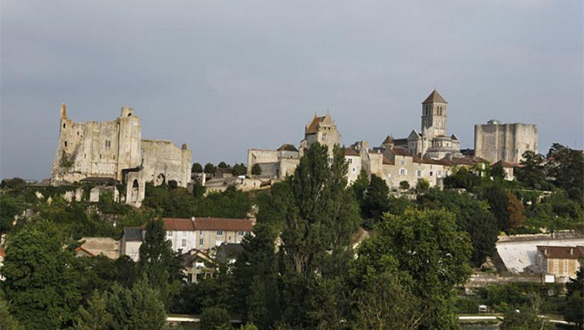 The Medieval city of Chauvigny (Vienne), an example of the variety of Romanesque architecture.
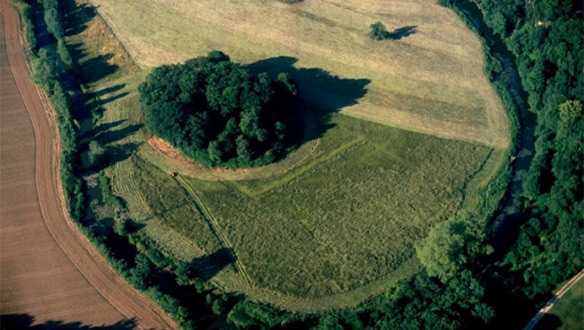 The mound at Curzay-sur-Vonne (Vienne).
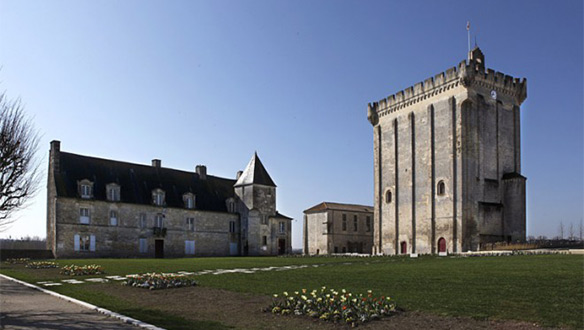 The castle of Pons (Charente-Maritime) : the Romanesque dungeon and, to its left, the 17th century abode.
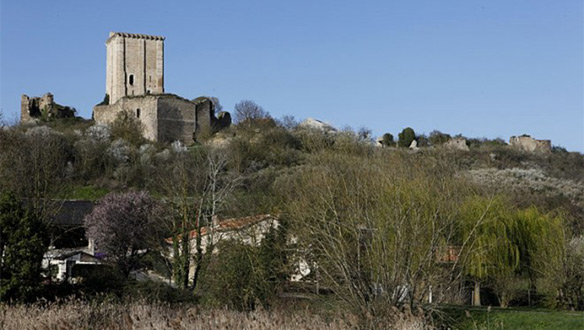 The castle of Moncontour (Vienne), a fortified site in the Dive valley.
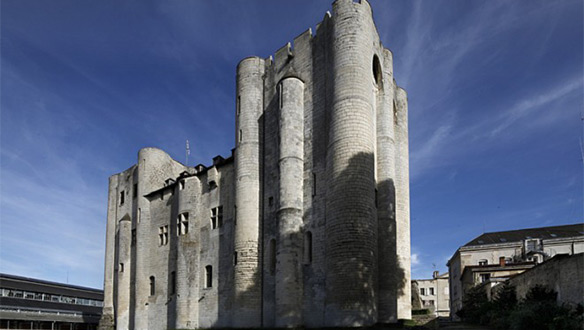 The dungeon of Niort (Deux-Sèvres), built by Henry II King of England or his son Richard the Lionheart.
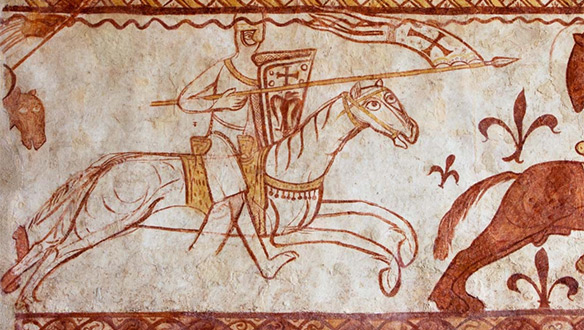 The chapel of Cressac at Cressac-Saint-Genis (Charente) and its late- 12th century frescoes.
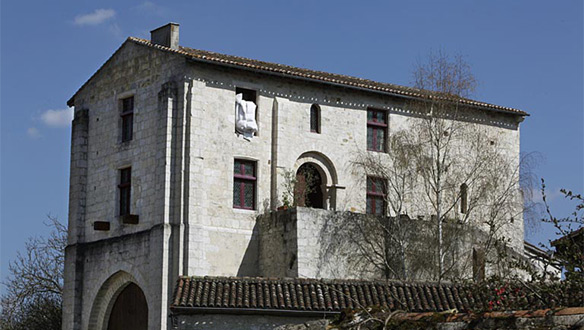 The castral chapel of Marthon (Charente), built above the castle’s entrance.
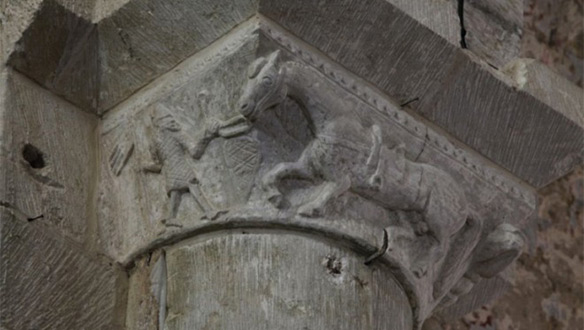 A sculpted knight on a capital at the church of Béceleuf (Deux-Sèvres).
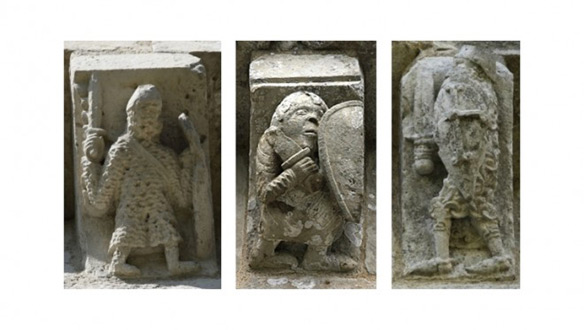 Crusaders, knights and soliders at Aulnay and Varaize (Charente-Maritime).
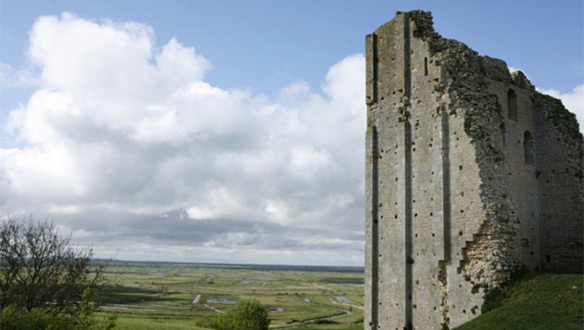 The Tower of Broue at Saint-Sornin (Charente-Maritime), vestige of the former Romanesque castle.


The 11th and 12th century correspond to a period of change, first in the political, religious and economic sphere, and also in architecture. During these two centuries, nearly two hundred castles were built on the territory of present-day Poitou-Charentes. Around thirty stone constructions subsist today, at Chauvigny, La Roche-Posay, Moncontour and Niort in the Vienne and Deux-Sèvres region, Marthon and Montignac, Pons and Saint-Sornin (Tower of Broue) in Charente and Charente-Maritime.
The castles are testimony to the political, social and territorial organization of the Romanesque period. Poitou-Charentes was then divided into three main counties (Poitou, Angoumois, Saintonge) and castellanies. It was ruled over by a suzerain lord, the Count of Poitou, who was also the Duke of Aquitaine. However, some lords refused to be under his tutelage and attempted to extend their territory through combat. They had castles built without obtaining prior consent from the Count, and thereby affirmed their presence and prepared their defense.
As a place of defense, of power and sometimes of daily life, castles usually included a surrounding earthen wall bordered by a moat which delimitated the elevated site of the castle.
The fortified sites often included a circular earthen mound, sometimes surrounded by a second wall, and a courtyard of varying size. The main tower, the « dungeon », which often rose two or three stories high, was usually built on the mound. The ground floor was often windowless ; the entrance door was at the level of the first floor. The courtyard sheltered one or many houses, stables, workshops and sometimes a chapel…
The wealth and power of the lords, as well as the defensive and/or symbolic role of the buildings, determined the importance of the castles. Castles could house the lords’ families or shelter a garrison.
Romanesque castles, built of wood or stone, suffered a lot throughout the centuries. The mounds were often lowered, even levelled, the courtyards and the dungeons dismantled…But they left traces in the landscape, some modest some spectacular, which tell us a lot about the life of the lords and knights.
The Lords: « those who wage battle »
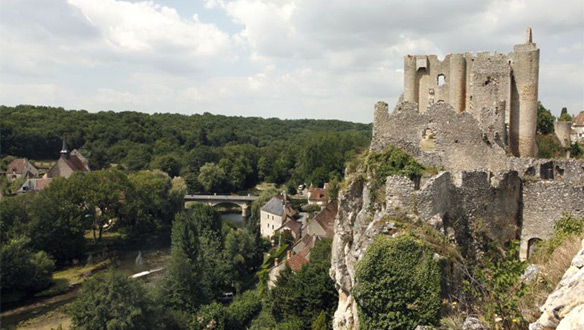 The castle of Angles-sur-l'Anglin (Vienne), property of the Lord-Bishop of Poitiers.
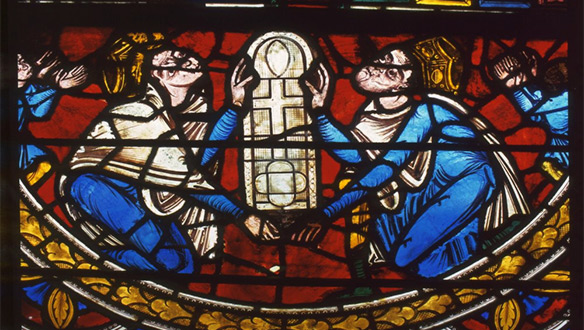 Eleanor of Aquitaine, Countess of Poitou, and her husband Henry II, King of England. Cathedral of Poitiers
 (Vienne).
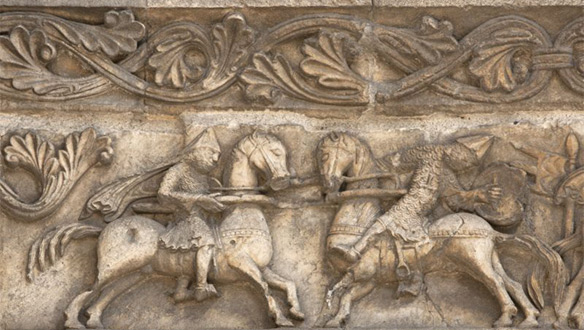 Two knights. Cathedral Saint-Pierre of Angoulême
 (Charente).
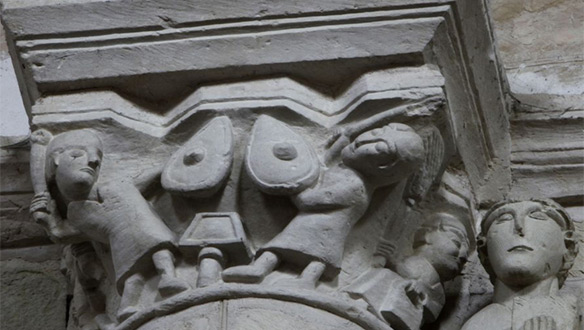 Soldiers in battle. Capital of the church of Airvault
 (Deux-Sèvres).
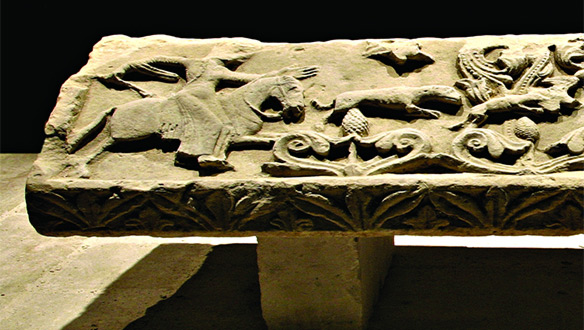 Noble lady hunting falcons, a lordly leisure. Tomb of Javarzay
 (Museum of Agesci, Niort).
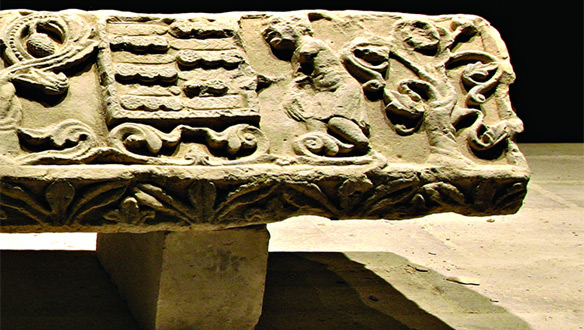 A game of tric-trac, which the lords enjoyed. Tomb of Javarzay (Museum of Agesci, Niort).
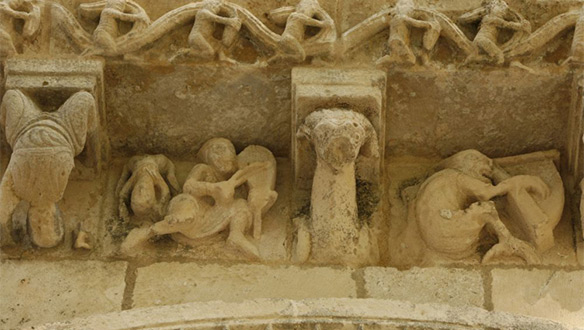 Acrobats and musicians : fiddlers, rote-harp players. Church of Surgères (Charente-Maritime).
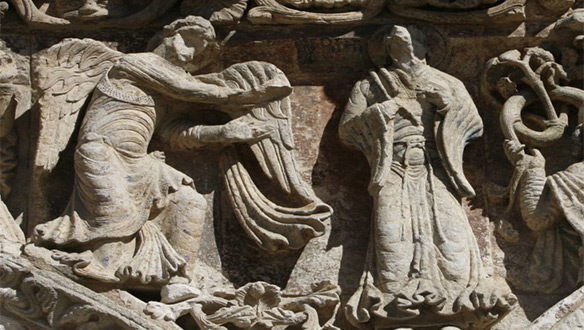 12th century dress and hairstyles. Church of Notre-Dame-la-Grande, Poitiers (Vienne).
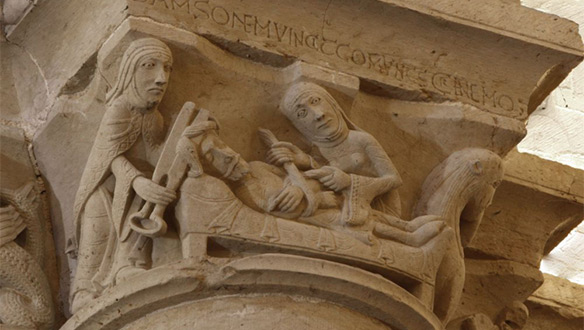 12th century furnishings and dress. Church of Saint-Pierre, Aulnay (Charente-Maritime).
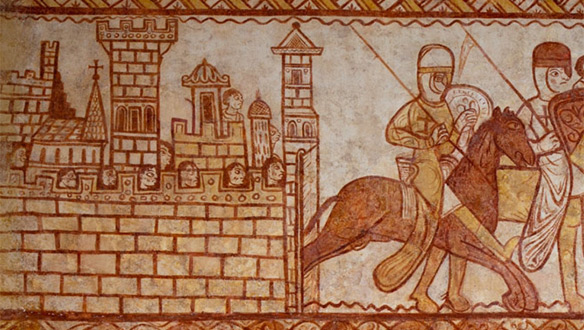 Fortified city and knights. Mural painting at the templar chapel of Cressac-Saint-Genis
 (Charente).
In the kingdom of the Franks, the 11th and 12th century corresponds to the strengthening of the feudal system. The fall of the royal power structure, in the 10th century, enabled the development of the great noble families who controlled territories of varying size. They created fiefdoms by often conceding these lands to lower-ranking lords. These vassals, who promised their loyalty in return, were often turbulent and questioned the authority of their suzerains.
The Guillaume family dynasty - which included the Counts of Poitou and the Dukes of Aquitaine and which progressively extended its domination over the areas of Angoumois and Saintonge - was contested by some vassals, such as the Lusignan family, the Counts of Marche, the Sires of Pons…
The lords expressed their power through the construction of castles ; over two hundred castles were built in the region. They were often built on mounds and were composed of a main tower (the dungeon) and an inner courtyard. The entire structure was protected by moats and earthen walls. The castles could be used for defensive purposes, or as a residence for the lord, as a hunting lodge…
The lords resided in the dungeons or in a dwelling in the courtyard. From there, they ruled over their fiefdoms. They would also organize celebrations there, with jugglers and musiciens, engage in chess games…They regularly trained for battle, organizing tournaments and hunting outings, one of their favorite hobbies.
They had peasants work the land they owned. In exchange for their protection, the lords required the peasants to serve in the armed forces and perform tasks. They also imposed a tax, as well as fees for the use of the mills and ovens.
At the heart of feudal society, the Lords also had the duty to defend the Church – the clergymen as well as its properties and holdings. They also had to respect the values of the Church and contend for the faith.
The paintings and sculptures of Romanesque churches are precious testimony to the life of the Lords : clothing, furnishings, weapons, musical instruments, games…
THE COUNTS OF POITOU
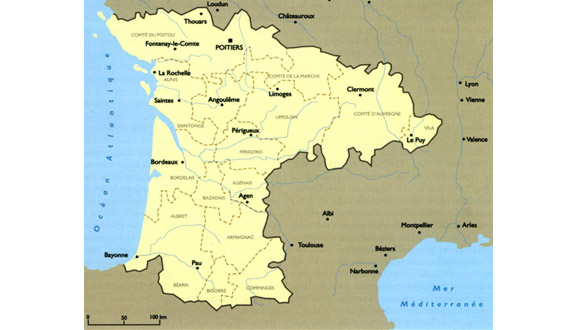 The Duchy of Aquitaine, upon the death of Guillaume X en 1137 (P. Brunello).
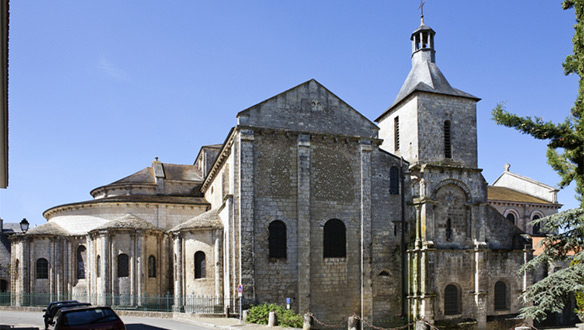 The church of Saint-Hilaire le Grand at Poitiers, rebuilt in the 11th century by the Countesses Emma and Agnès.
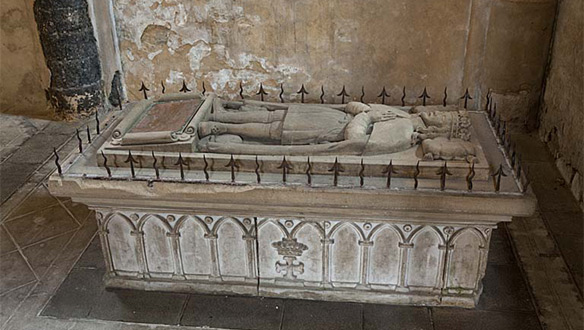 19th century recumbent effigy of Guillaume VIII (1058 - 1086). Church of Saint-Jean de Montierneuf, Poitiers.
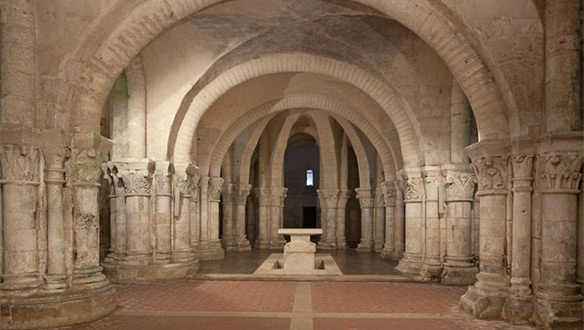 The crypt of the church of Saint-Eutrope at Saintes, given by Guillaume VIII to the Abbey of Cluny in 1081.
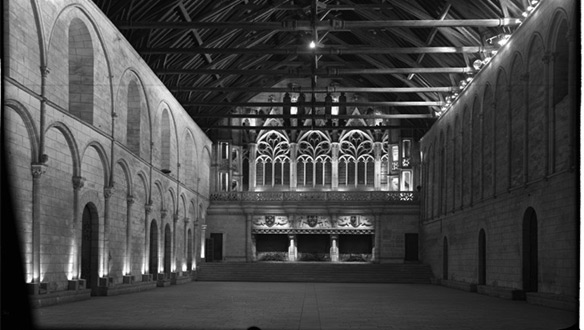 The great hall at the Palace of the Counts, at Poitiers. Built by Eleanor of Aquitaine.
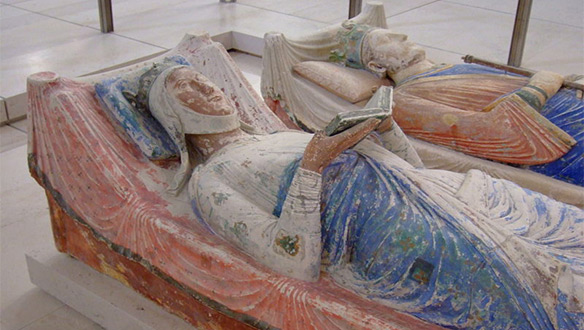 The recumbent effigies of Eleanor of Aquitaine and Henry II, at the Abbey of Fontevraud (Maine-et-Loire).
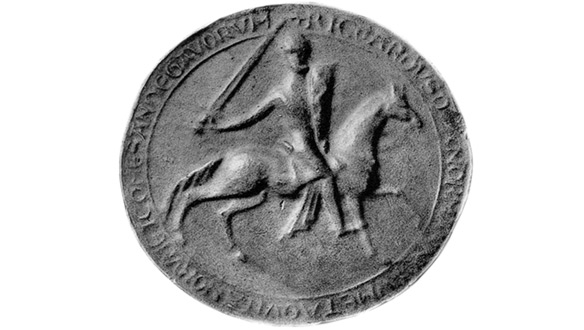 Drawing of a counter-seal of Richard the Lionheart, Count of Poitou, Duke of Aquitaine through his mother, Eleanor.
In the Romanesque era (11th and 12th century), the present-day region of Poitou-Charentes was divided into three main counties, whose borders often changed : Poitou, Angoumois and Saintonge. The Counts of Poitou, who were also the Dukes of Aquitaine, progressively came to rule over these territories. They constituted one of the greatest families of the Frankish kingdom.
Their power dates back to the Carolingian era, when Charlemagne created a new territorial administration to rule over his empire, organizing it into Counties and Duchies. He appointed Counts and Dukes to rule over these territories - like Abbon, in 778, for the county of Poitiers. He granted them full authority to ensure peace, render justice and collect taxes within their respective territories.
In the 9th and 10th century, Viking invasions and political troubles stemming from the division of the empire (in 843) led to the fall of the central power. Thus, the Counts, Dukes and other noble families conquered vast territories, which they often conceded to vassal lords. Starting in the 10th century, the Counts and Dukes began bestowing on their descendants rights which had previously been granted by the king or emperor.
In this way, the Guillaume family progressively took over the County of Poitou and the Duchy of Aquitaine, the counties of Limousin, Saintonge and Angoumois (despite fierce resistance from the Counts of Angoulême). And it reigned over these territories for more than two centuries. The last representative of this family is Eleanor of Aquitaine (1122 ? – 1204), who married the King of France and later the King of England. Among the other famous members of this dynasty are Guillaume V (995-1030), who met with the Emperor of Germany and the Kings of France, Italy and England. He was « admirable for his wisdom, full of a liberal generosity, a defender of the poor, a builder of sanctuaries » (Adémar de Chabannes). And William IX The Troubadour (1071-1126), who invented courtly poetry : « All the joy in the world is ours, lady, if we love each other ».
The Church and the Clergy: « those who pray»
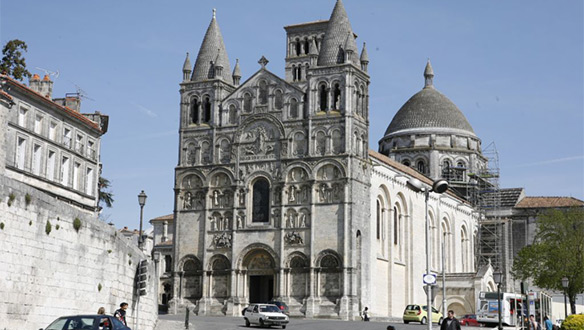 The Romanesque cathedral of Saint-Pierre at Angoulême (Charente), built by the bishop Girard II.
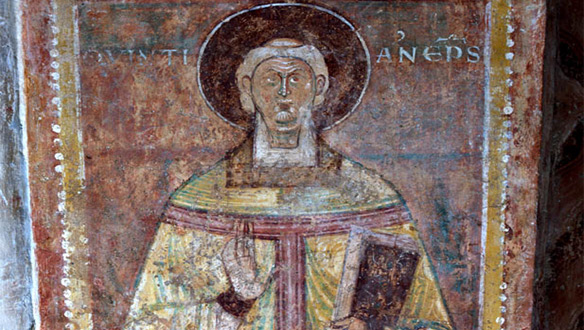 Mural painting representing a bishop. Church of Saint-Hilaire at Poitiers (Vienne).
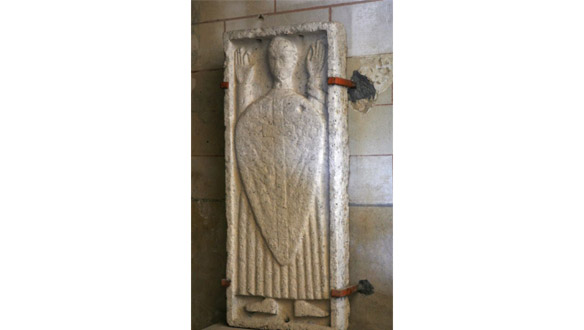 A tombstone representing a priest, praying with raised hands. Church of Anché (Vienne).
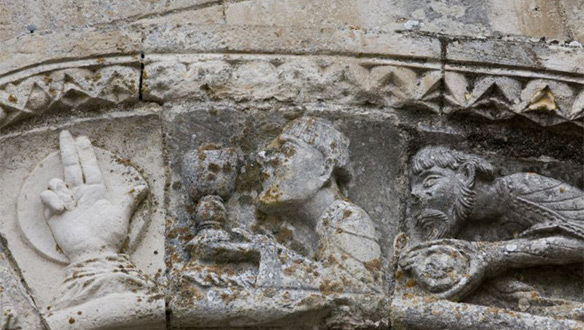 Monk with a chalice and a paten, objects used in mass. Church of Champagne-Mouton (Charente).
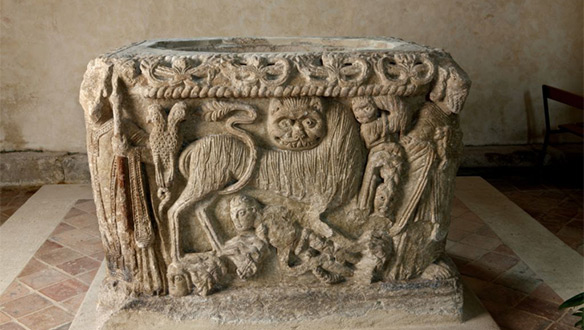 A 12th century baptismal tub. Church of Ars (Charente).
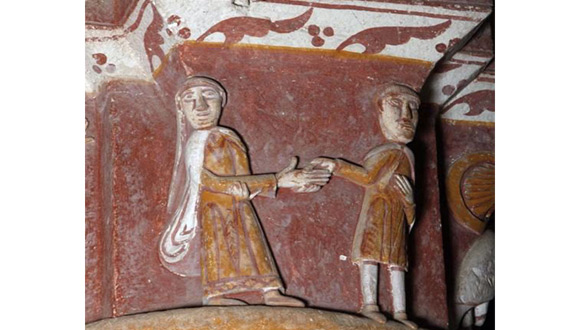 Scene from a wedding. In the 12th century, weddings started to become a religious ceremony. Church of Civaux (Vienne).
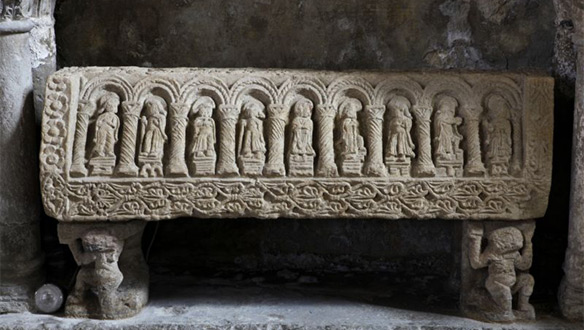 Tomb of Pierre de Saine-Fontaine. He was a reformist abbot at the Abbey of Airvault. Church of Airvault (Deux-Sèvres).
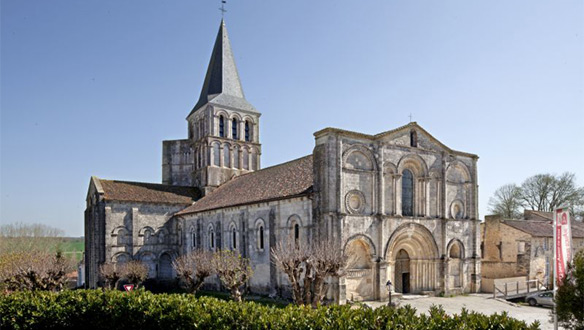 Abbey church of Saint-Amant-de-Boixe (Charente), rebuilt in the 12th century.
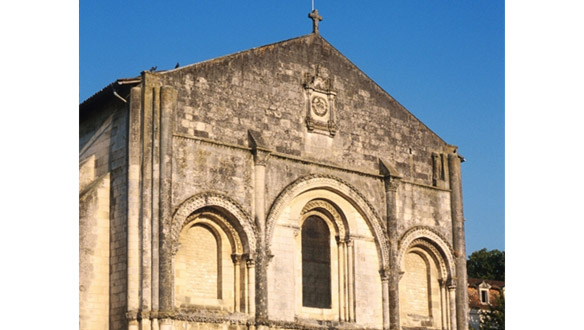 Abbey of the Ladies, a women’s monastery founded around 1047 in Saintes (Charente-Maritime).
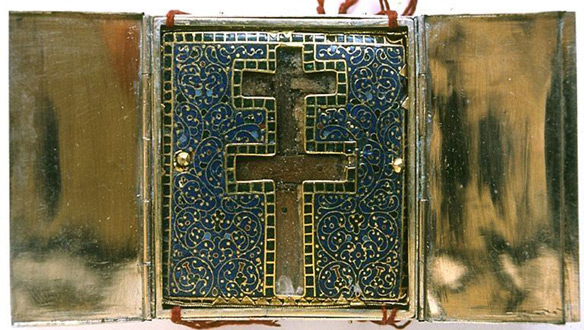 11th century reliquary of the True Cross preserved until 1792 at the Abbey of Sainte Croix in Poitiers.
The Church was made up of a regular clergy, where monks and nuns lived in the monasteries, and of a secular clergy, where the bishops and priests worked within their diocese and their parishes (the network of parish churches was established in the 11th century).
Throughout the 11th and 12th century, the Church’s former power was diminished by feudal battles. Pope Gregory VII (pope from 1073-1095) undertook vast reforms within the Church. The Pope became the sole leader of the Church and of Christianity, and he named the Bishops. The clergy had to adopt a more rigorous lifestyle and the lords had to restitute the Church belongings they had seized…
In the monasteries, the Rule of Life had to be strictly observed. The most common rule was the Rule of Saint Benedict, who divided time between manual work, spiritual work (reading and meditating on the scriptures) and group prayer. The monasteries played a major economic role in the development of the land : clearing land, drying up marshes, developing salt marshes, establishing vineyards…In this context of reforms, the Cistercian order, among others, was founded with Bernard de Clairvaux (1090-1153) as its main spiritual leader.
In the parishes, the priests accompanied the worshippers throughout their life : from their baptism to their religious marriage – a custom which gradually established itself - to their burial. The Gregorian reforms rendered celibacy and teachings obligatory for the priests ; they also prohibited them from selling indulgences (to buy back sins).
The reformed clergy propagated the Christian values that were to structure civilian society. The numerous constructions of stone churches that followed the reforms also participated in spreading these values through paintings and sculptures.
The small parish churches, great monasteries, cathedrals and pilgrimage churches where the relics of the saints were worshipped… all contributed to developing the power of the Church throughout the Romanesque period.
The peasants, the artisans, the merchants…:
« those who worked »
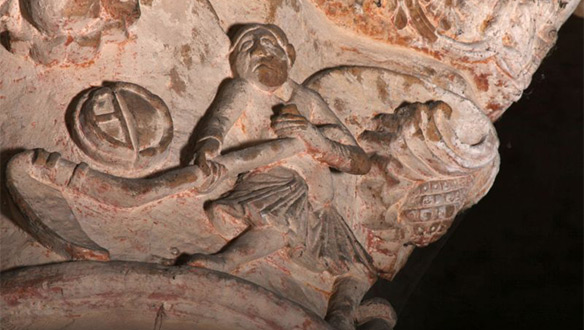 Pesant reaping wheat. Capital at the church of Airvault (Deux-Sèvres).
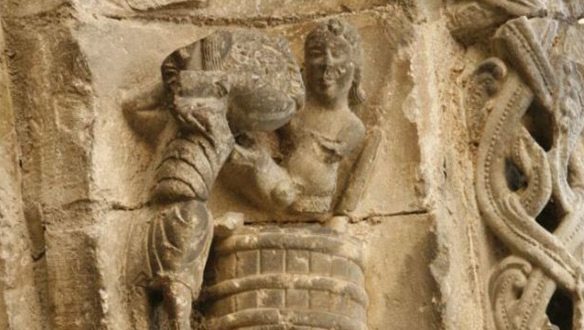 Stomping grapes in September. Zodiac and monthly works at the church of Civray (Vienne).
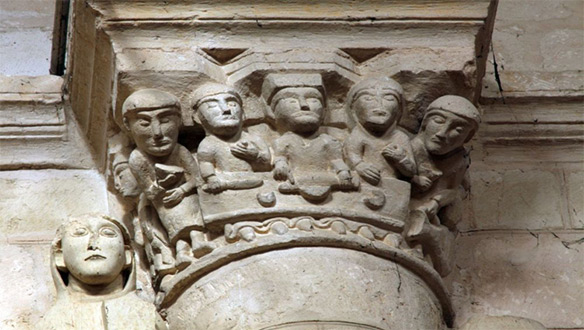 Scene of a meal (Wedding of Cana?). Capital at the church of Airvault (Deux-Sèvres).
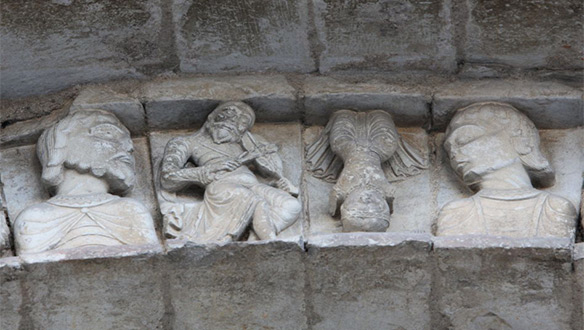 Musician (fiddler) and acrobat. Facade of the church of Civray (Vienne).
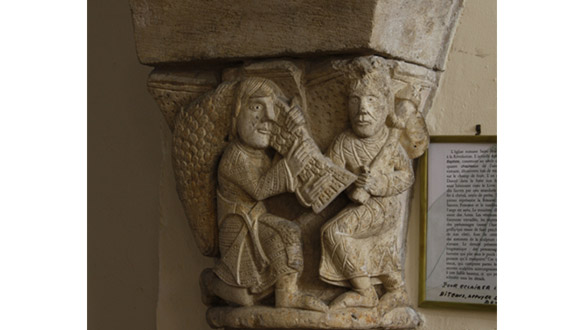 Enigmatic scene with figures in bourgeois clothing. Church of Saujon (Charente-Maritime).
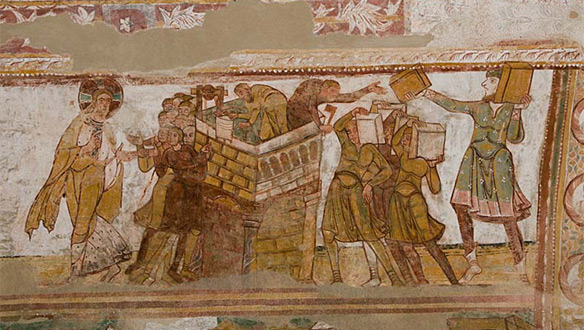 Construction of the Tower of Babel : masons, manœuvers, architect... Abbey of Saint-Savin (Vienne).
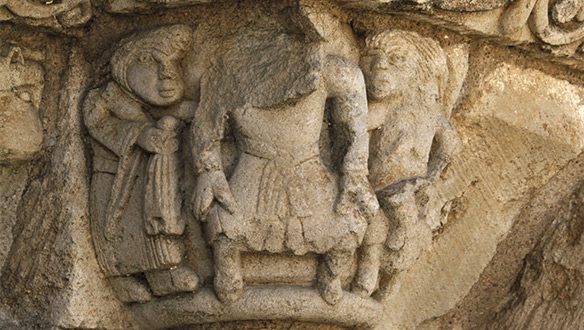 Servants (?) around a seated figure. Church of Vaux (Vienne).
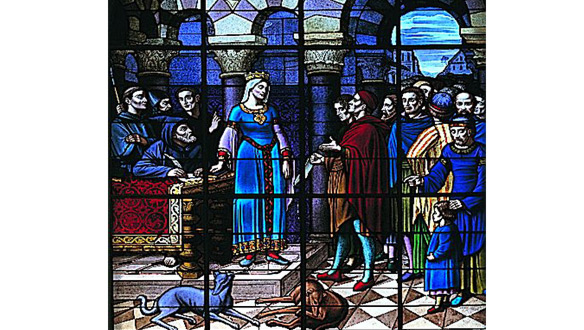 Eleanor giving the township charter to the people of Poitiers.19th century stained-glass window. City Hall of Poitiers.
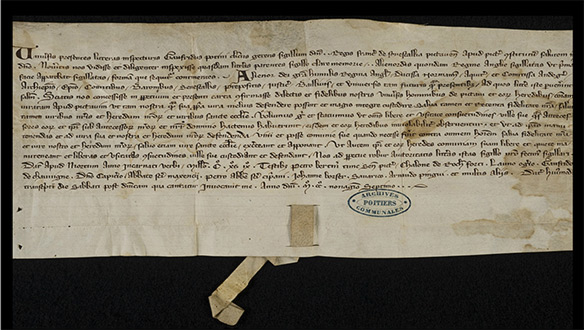 The township charter given by Eleanor, Countess of Poitou, to the people of Poitiers in 1199.
The two centuries (11th and 12th) that cover the Romanesque period coincide with a period of economic and demographic expansion, and with cultural developments that were strongly tied to developments in religion and feudality. Society was then organized into three groups : the lords, the Church and the peasants, artisans and merchants.
The third group of feudal society included a class of workers. The workers were mainly peasants who worked the land of their secular or religious lord, in exchange for his protection. New agricultural techniques developed, like the triennial rotation of cultivated land and fallow land, the pulling harness and the shoulder brace for plow animals. Farmed lands expanded and production increased so as to meet the increasing needs of society. Mills flourished ; used in agriculture, they were also used for textiles and metallurgy.
Economic activity did not derive solely from agriculture. Artisans and merchants worked in the newly developed cities…The progressive pacification of feudal society facilitated trade and commerce, which created wealth. Cities played a greater and greater role and their residents (the « bourgeois ») obtained rights and privileges. The township charters were created in 1175 for La Rochelle and Poitiers by Henry II, King of England, husband of Eleanor of Aquitaine, the Countess of Poitou and Duchess of Aquitaine, who confirmed the charters in 1199.
Previously not well known, the living conditions of the population in the Romanesque period are better documented today, especially thanks to archaeological digs. Romanesque paintings and sculptures bear testimony to the activities of daily life.
Resources
The interviews
- At Chauvigny, the historian Christian Rémy discusses the feudal system and tells us about the castles and the life of the lords.
Download the text - At the Abbey of Marcillac-Lanville, the director of the association Via Patrimoine Lætitia Copin-Merlet discusses the power of the clergy, the construction of numerous churches, the pilgrimages, the peasants and economic development.
Download the text
Focus
- The counts of Poitou
Download the text - The lords : « those who wage battle »
Download the text - The Romanesque castles
Download the text - The Church and the clergy : « those who pray »
Download the text - The peasants, the artisans, the merchants... : « those who work »
Download the text
The interviews
- In the churches of Saint-Eutrope at Saintes and Notre-Dame la Grande at Poitiers, Christian Gensbeitel, lecturer in Medieval Art History, discusses Romanesque art, its origins and its various modes of expression.
Download the text - At the church of Saint-Pierre d'Aulnay, the poet and writer Rémy Prin shares his passion for the Romanesque world and the sculptors’ exceptional work.
Download the text - At the abbey of Saint-Savin, the heritage mediator Marie-Anne Lacaille shows us the remarkable mural paintings that are listed on the World Heritage List.
Download the text
The focus
- The church of Saint-Eutrope at Saintes : an innovative sculpture
Download the text - The church of Notre-Dame la Grande at Poitiers : a new architecture
Download the text - The church of Saint-Pierre at Aulnay : a book of stone images
Download the text - The church of Saint-Savin : the « Sistine Chapel of the Romanesque world»
Download the text
The interviews
- The Regional Curator of Historical Monuments Pierre Cazenave and the Vice-Regional Curator of Archaeology Didier Delhoume, both at the Regional Department of Cultural Affairs of Poitou-Charentes discuss the future restoration of the cathedral of Angoulême’s facade.
Download the text - Anne Embs, the Vice-Regional Curator of Historical Monuments at the Regional Department of Cultural Affairs of Poitou-Charentes and Brice Moulinier, restorer of mural paintings, explain the restoration of the paintings at the templar chapel of Cressac-Saint-Genis.
Download the text - Anaël Vignet, Director of the Center of Romanesque Architecture and cultural mediator at the Abbey of Saint-Amant-de-Boixe, discusses her role as a mediator of Romanesque art.
Download the text -
The designer Mathieu Lehanneur tells us about his work at the church of Saint-Hilaire at Melle, where he redesigned the choir using Romanesque and contemporary styles
Download the text - The audience during the opening night of the Romanesque Nights at Saint-Savin on June 28, 2014. Organized by the Poitou-Charentes Region, the festival celebrated its tenth anniversary and performed 250 free performances and 170 nightly events throughout the summer.
- Angoulême, cathedrale of Saint-Pierre
Discover - Visit - Aubeterre-sur-Dronne, church of Saint-Jean
Discover - Visit - Cressac-Saint-Genis, chapel of the Templars
Discover - Lichères, church of Saint-Denis
Discover - Marcillac-Lanville, church of Notre-Dame
Discover - Saint-Amant-de-Boixe, Abbey of Saint-Amant
Discover - Visit
- Aulnay, church of Saint-Pierre
Discover - Saintes, church of Saint-Eutrope
Discover - Visit - Saint-Sornin, dungeon of Broue
Discover - Talmont-sur-Gironde, church of Sainte-Radegonde
Discover - Visit
- The Romanesque heritage of Poitou-Charentes, on the site of the Heritage Inventory Office of the Nouvelle-Aquitaine Region.
- Romanesque monuments of Poitou-Charentes
- Portal of the Romanesque Era of Poitou-Charentes, designed by the Museum Council, in partnership with the Ministry of Culture and the Poitou-Charentes Region.
- The site of the Regional Office of Cultural Affairs of Nouvelle-Aquitaine.
Credits
A WEB-DOCUMENTARY OF THE NOUVELLE-AQUITAINE REGION

Coordination :
Jean Jay, Yann Ourry
Writing and Editing (focus) :
Véronique Dujardin, Marie-Paule Dupuy, Yann Ourry, Christine Sarrazin, Catherine Tijou.
Interviews with :
Pierre Cazenave, Lætitia Copin-Merlet, Didier Delhoume, Anne Embs, Christian Gensbeitel, Marie-Anne Lacaille, Mathieu Lehanneur, Brice Moulinier, Rémy Prin, Christian Rémy, Anaël Vignet.
Journalist :
Mélody Szymczak
A web-documentary directed and produced by Vue du Phare production.

Director & Executive Producer : Arnaud Chastanet
Producers : Arnaud Chastanet, Amandine Faugeron
Chief Cameraman : Romain Carcanade
Technical Director : Filip Trad
Camera operator : Guillaume Génini
Music & Sound Recording : Augustin Arbon
Editing : Filip Trad, Arnaud Chastanet
Web design : Agence Sweet Punk
Drone pilot : Rémy Semidei
Additionnal drone pilot : Romain Watier
Motion Design : Fabrice Vacher
Calibration : Mathieu Nieto
Journalist : Mélody Szymczak
Voice over : Chloé Dunn
Translation : Tatyana Baishanski
Thanks to the owners and managers of the sites filmed. Special thanks to the EPCC Abbey of Saint Savin / Valley of Frescoes, to the Abbey of Saint-Amant-de-Boixe and to the United Protestant Church of Barbezieux (chapel of Cressac-Saint-Genis).
Disclaimer
Publishing Director : Aurélie Loubes, Director of Communication of the Nouvelle-Aquitaine region.
Publishing : The Heritage Department of the Nouvelle-Aquitaine region.
Status
The territorial authority of the Nouvelle-Aquitaine region
14 rue François de Sourdis
33077 Bordeaux Cedex
Tel : 05 49 36 30 05
Mail : s.patrimoine@nouvelle-aquitaine.fr
Production
Vue du Phare production
Siège social : 57 boulevard Poniatowski 75012 Paris
RCS de Paris : 524 458 262
info@vueduphare.com
Host
Netissime.com - Groupe e.l.b. Multimedia
45/47 rue Francis de Pressensé
69100 Villeurbanne, France
Data Protection
You have the right to access, modify, rectify and delete your personal data on file (article 34 of the Data Protection Act). To exercise this right, send an email to the following address: s.inventaire@cr-poitou-charentes.fr
Copyright and Reuse of Content
All content herein is published by the Nouvelle-Aquitaine Region.
The content herein may not be reproduced without prior consent. Any reuse or reproduction of content must indicate the original source.
To request authorization to reproduce or reuse any content, please contact: s.patrimoine@nouvelle-aquitaine.fr
Furthermore, the reuse or reproduction of any content may only be permitted for personal, organizational or professional purposes. Distribution or reuse for commercial or marketing purposes is prohibited. The establishment of « deep links » to the document in question is promoted, and the reproduction of the content herein must be as limited as possible. Establish a link to the web-documentary « Romanesque Treasures ».
Any Internet site and any other support is authorized to use a hypertext link directing users to this portal. The authorization for the establishment of a link is valid for any and all supports, with the exception of those which disseminate information of a controversial nature, pornographic material or xenophobic material, or those which are liable to offend the greater majority.