






Vous souhaitez être prévenu de la mise en ligne des prochains films ?
Traveling through these historical lands, we discover the known and unknown treasures of the Poitou-Charentes region.
In the crypt of the church of Saint-Eutrope at Saintes, we describe the origins of Romanesque art. Christian Gensbeitel traces the development of this art over two centuries, and describes its various modes of expression. We continue the discussion in Poitiers, before the church of Notre-Dame-la-Grande, where we delve into Romanesque sculpture and painting with Christian Gensbeitel.
We pursue our discovery of Romanesque art alongside Rémy Prin, who passionately describes the Romanesque sculptures at Aulnay, considered as one of the major works of Romanesque art and one of the most beautiful representations of the Medieval imaginary.
We conclude our tour at the Abbey of Saint-Savin, where we meet with Marie-Anne Lacaille. She talks with us about the splendid paintings which decorate the edifice. Together, we take in the « Sistine Chapel of the Romanesque World », a UNESCO World Heritage Site.
Christian Gensbeitel, Lecturer in Medieval Art History at the Michel de Montaigne-Bordeaux 3 University, former director of the Atelier du Patrimoine of Saintonge, at Saintes.
Through his writings, he works to promote the Romanesque heritage of his region and to make it accessible to all.
Rémy Prin, a trained researcher, is a poet and writer who loves the Romanesque world.
His writings travel through the sites of Romanesque art, seeking their present-day relevance.
Marie-Anne Lacaille, Mediator at the Abbey of Saint-Savin
Her expertise resides in explaining the codes and language of Medieval imagery.
Notre-Dame la Grande at Poitiers, a new architecture
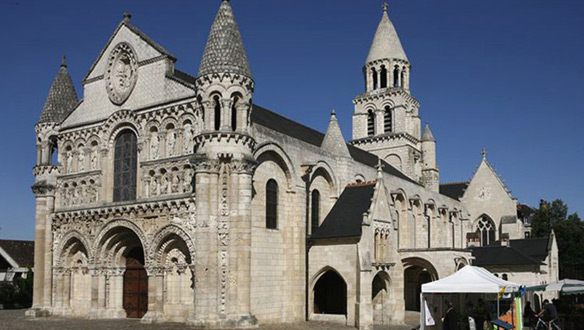 The church of Notre-Dame la Grande at Poitiers.
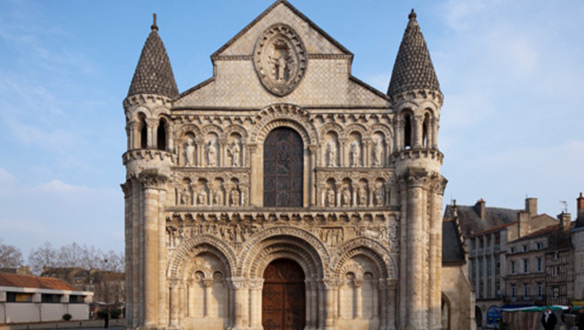 Facade of the church.
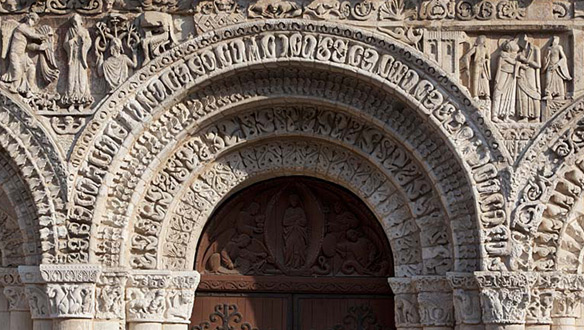 The richly decorated arch of the main portal on the church’s facade.
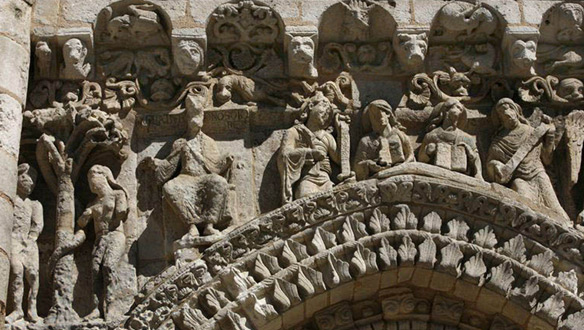 Detail of the frieze on the church’s facade, depicting many scenes from the Old Testament.
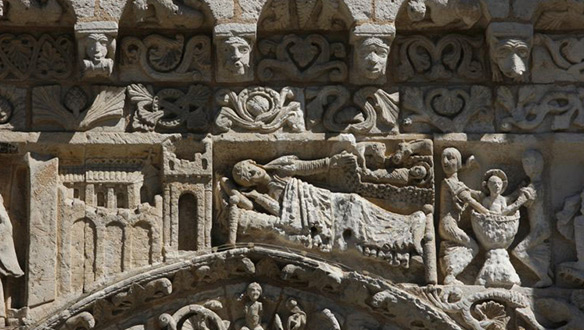 Detail of the frieze on the church’s facade, depicting the Nativity scene.
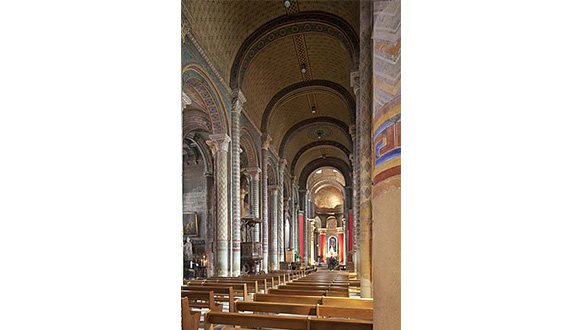 The church’s nave, seen from the entrance, facing the choir.
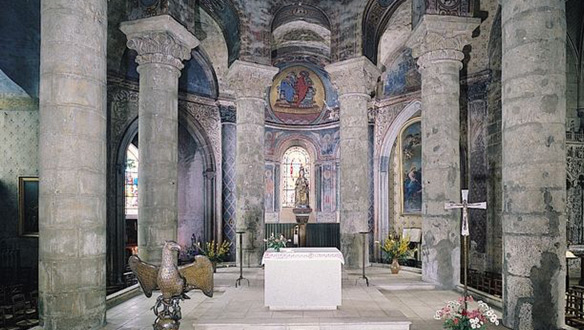 The choir of the church of Notre-Dame la Grande at Poitiers.
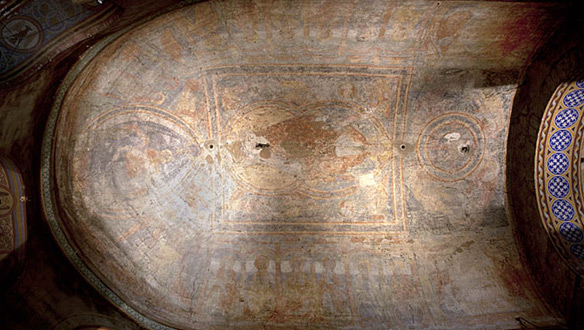 The mural paintings on the semi dome vault in the church’s choir.
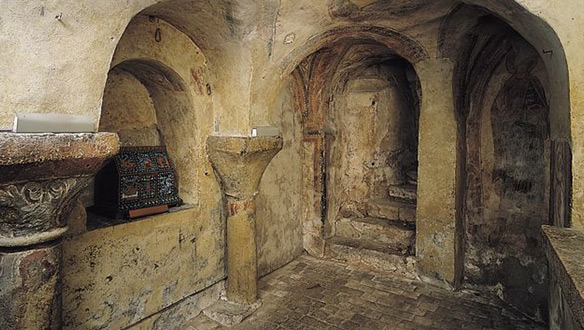 The crypt at the church of Notre-Dame la Grande.
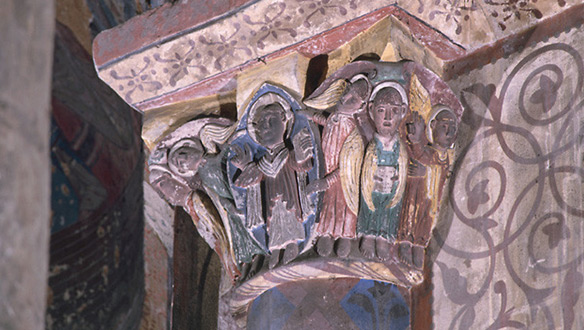 A capital in the deambulatory at the church of Notre-Dame la Grande, representing the Ascent of Christ.


The church of Notre-Dame la Grande at Poitiers, in the Vienne region, is one of the most famous Romanesque monuments of Poitou-Charentes. Documented as early as the 10th century, it combined the functions of a parish church (for the residents of the parish) and a collegiate church (served by the clergy and the canons). It was rebuilt from 1030 to 1080. Its design and its stone cover are examples of the new religious architecture that developed in the 11th century.
Built above a crypt, the choir was built on an innovative design : it is surrounded by a deambulatory (a half-circular hall) which gives out onto three chapels. This created space for more altars, thereby making additional room for the prayer services of the canons, for whom the space was reserved.
The nave, which welcomed the parishioners, had to be well-structured. While building it, the constructors decided to create a vault. They covered the central nave with a barrel vault arch and side cross-vaults that nearly rise to the same heigth. This type of covering, which became often used in Poitou, created a reciprocal counter-buttressing of the vaults.
The main decor of the 11th century church, the religious message, was then painted. Created in the second half of the century, the paintings subsist in the crypt and on the choir’s vault, representing the Virgin with Child, Christ in Glory, the Lamb and the apostles. The paintings in the nave date back to the 19th century.
Decorative sculptures adorn the capitals of the pillars. They are inspired by Antiquity (Corinthian capitals) in the choir, and evolve into original plant motifs in the nave. Among the rare figurative capitals, a remarkable sculpture depicting the Ascent of Christ is the oldest historiated capital of the Poitou region.
The current facade was created from 1115 to 1130, following the extension of the nave to the west. It displays a remarkable sculpted ensemble, which testifies to the developments in sculpture in the 12th century. The sculpted scenes, which are exceptional due to their great number and quality, are an affirmation of the Christian faith and prominently display religious scenes. The most famous sculpture is a frieze on the ground level that illustrates the story of the Incarnation, from Adam and Eve to the Childhood of Christ.
The church of Saint-Eutrope in Saintes : innovative sculpture
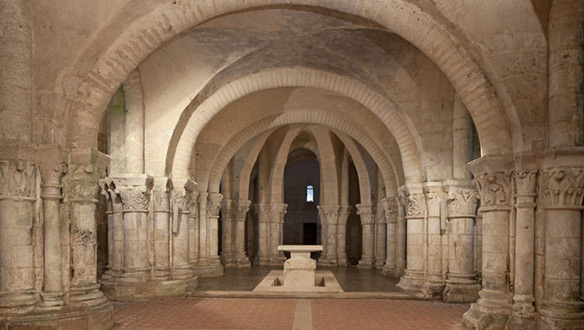 The crypt.
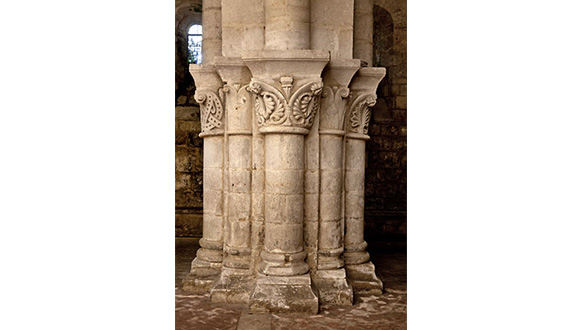 Pillar of the crypt. Capital decorated with foliage.
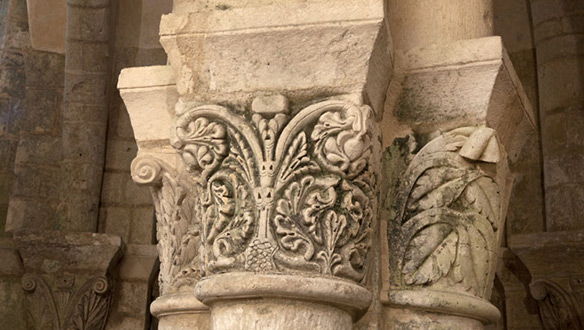 Foliage. Capital of the crypt.
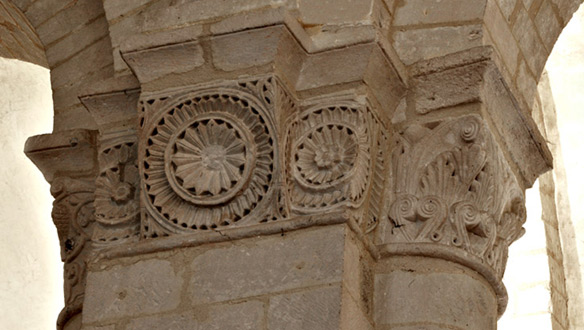 Foliage. Capital of the choir.
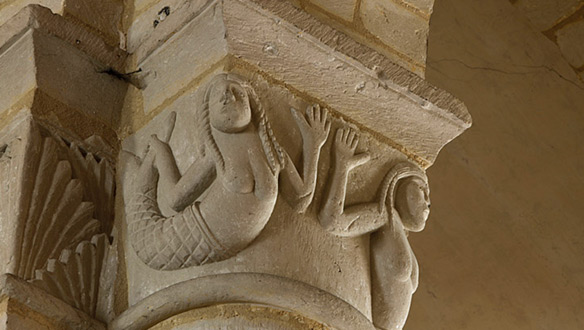 Sirens. Capital of the choir.
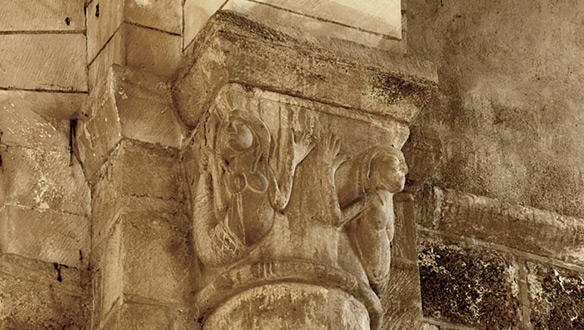 Sirens similar to those at Saint-Eutrope. Capital of the church of Saint-Pierre at Parthenay-le-Vieux.
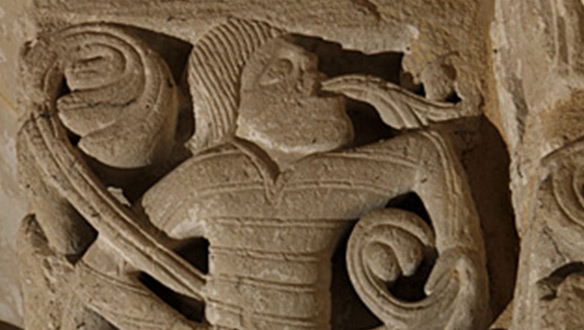 Man and foliage. Capital of the transept.
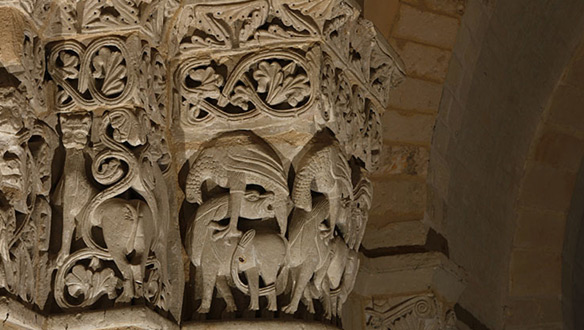 Birds perched on lions and foliage. Capital of the transept.
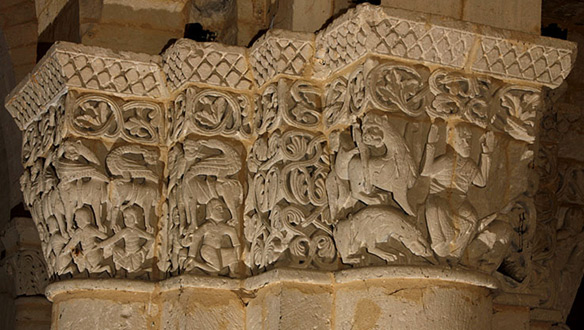 Kneeling figures, lions, birds and Daniel in the Lions’ Pit. Capital of the transept.
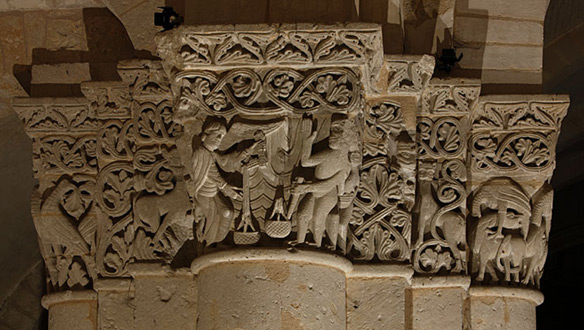 The Weighing of Souls. Capital of the transept.
Attested to as early as the 6th century, the church of Saint-Eutrope at Saintes, in the Charente-Maritime region, was built around the tomb of Saint-Eutropius. According to legend, this saint was the first bishop of Saintes, and the evangelizer of Saintonge. In the late 11th century, the monks from the Abbey of Cluny rebuilt a bigger church on an atypical design : with a long nave, a transept and a deep choir built on a vast crypt that took in the relics of the saint in 1096. This Romanesque church was often rebuilt and mutilated during the following centuries. In the areas that remain today (the crypt, the choir and the transept), remarkable sculpted capitals bear testimony to the developments in Romanesque sculpture in the late 11th and early 12th century.
The capitals in the crypt and the choir were created in the late 11th century. Those in the crypt, numbering 53, are decorated with plant motifs. The Romanesque artists sculpted small palm trees, acanthi and foliage. Foliage often embellishes the corners and spreads out symmetrically over the corbel. These motifs originate from the decorative repertory of Antiquity. Some bring to mind the sculptures of the Roman buildings that were preserved in Saintes. The old choir displays capitals similar to those in the crypt, except for the three capitals decorated with sirens, lions and griffins, whose style is linked to the sculptures of Poitou.
The transept was created a few years after the crypt and the choir was built in the early 12th century. The sculptors were very innovative here, creating new figures that appeared at this time in other art forms, notably in the illuminations of manuscripts. They adorned the capitals with figures of men, animals and plants, mixing them together and juxtaposing them. Two capitals illustrate religious scenes : the Weighing of the Souls and Daniel in the Lions’ Pit. This was a great novelty in Saintonge. The capitals of the transept were the basis of an artistic development - also on display nearby, at the Abbey of the Ladies in Saintes – that spread throughout Saintonge and beyond. It illustrates the important developments that Romanesque sculpture underwent in the early 12th century.
The church of Saint-Pierre at Aulnay :
a book of stone imagery
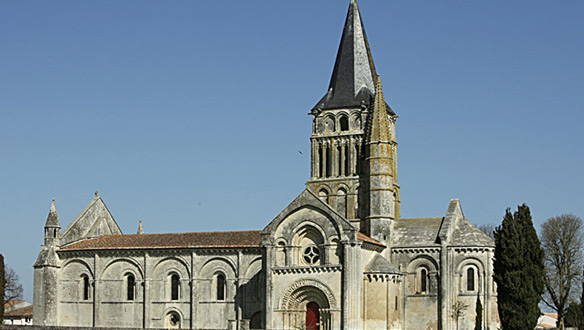 The church’s southern elevation point.
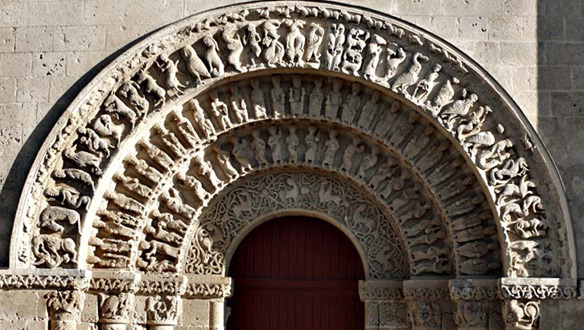 Portal of the southern transept.
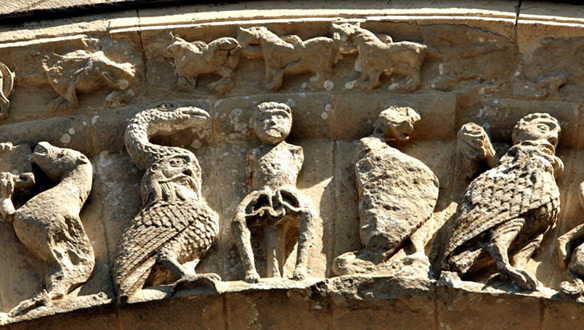 Caladrius and his patient, siren-bird. Sculpted bestiary on the south portal.
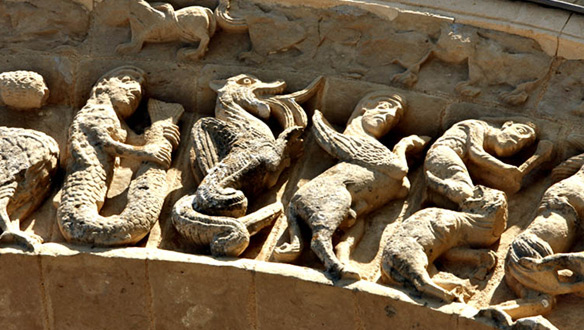 Siren, dragon, winged horse with human head, animal devouring a human. Sculpted bestiary on the south portal.
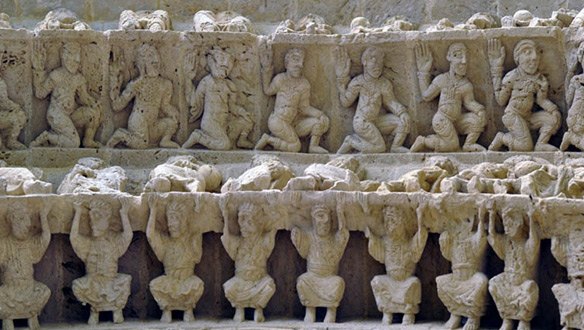 Atlanteans and kneeling figures raising their right hand. Intrados of the scrolls on the south portal.
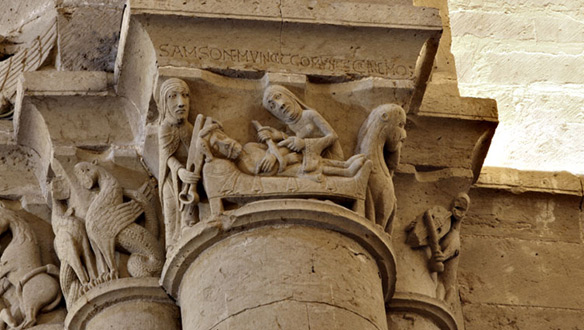 Samson and Dalila. Capital of the transept crossing.
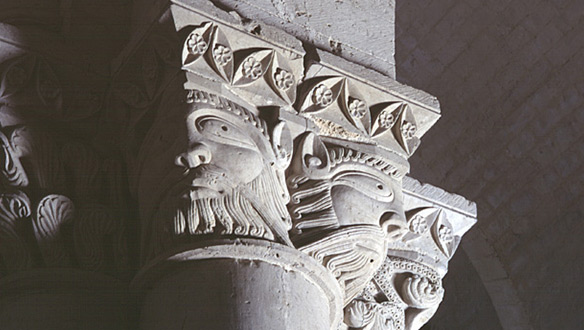 Human masks. Capital in the nave.
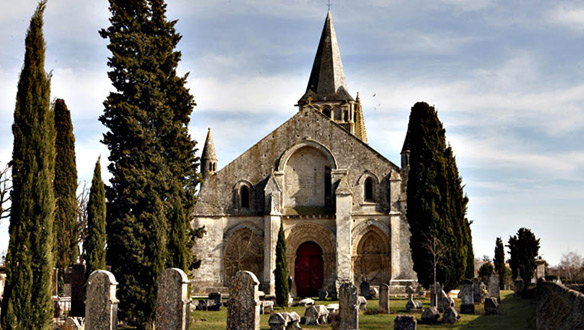 The church’s west facade.
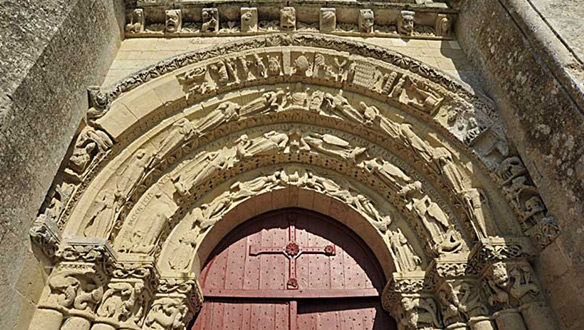 Portal of the west facade.
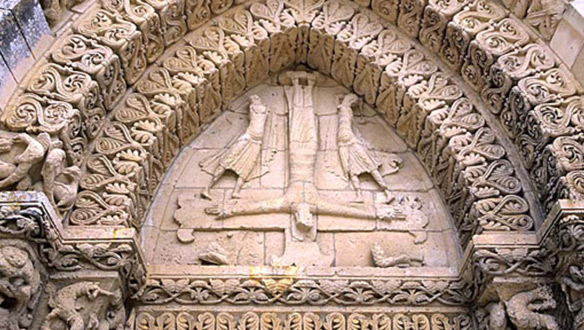 The crucifixion of saint Peter. Sculpture on the west facade.
The church of Saint-Pierre at Aulnay, in the Charente-Maritime region, was built in the early 12th century. Along with the church of Notre-Dame-la-Grande in Poitiers and the cathedral of Angoulême, it is one of the monuments of Poitou-Charentes where Romanesque sculpture is the most complete.
The church of Saint-Pierre, commissioned by the monks of the cathedral of Poitiers, displays exceptional qualities : a balanced architecture, sculptures of a great quality, preserved in their near totality, and an ambitious religious program. Using the innovative sculptures from the church of Saint-Eutrope in Saintes, the artists at Aulnay perfected the technique and created a profusion of sculptures all over the monument, inside as well as out. Sculptures can be seen on the facade, the portals, the bays and cornices…These stone images consequently became the primary medium for communicating the religious message.
These rich decorations were created by three teams of sculptors. One of them worked on the apse, in the transept, as well as on the south portal. The four scrolls on this portal are adorned with animals and foliage, with the Old Men of the Apocalypse, with saints and a procession of real and imaginary animals depicted with verve in a lively manner. In the transept, many historiated capitals represent Adam and Eve, Caïn and Abel, Samson and Dalila…
The capitals in the nave are the work of a second team. These capitals are adorned with animals, plant motifs and human masks. The motifs are often organized symmetrically to create a balanced and simplified composition that is easy to decipher.
The decor of the west facade was created by a third team, whose style is characterized by elegant, willowy figures, and large-scale sculptures with pronounced reliefs that follow the curves of the scrolls. The portal’s arch displays illustrations of the Lamb surrounded by angels, the battle between Vice and Virtue, the Wise and the Foolish Virgins and the zodiac. This portal is flanked by two blind arcades with sculpted spandrels. The crucifixion of Saint Peter is depicted on the one on the left.
The extensive influence of the sculpture at Aulnay is particularly visible in Saintonge, as attested by the churches of Chadenac and Fenioux, and in the neighboring areas.
The church of Saint-Savin :
the « Sistine Chapel of the Romanesque Period »
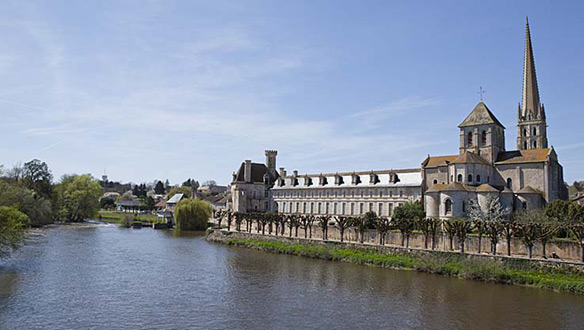 The apse of the Romanesque church and the 17th century monastic building.
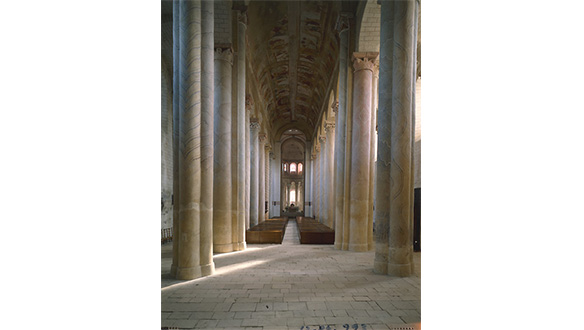 The church’s nave.
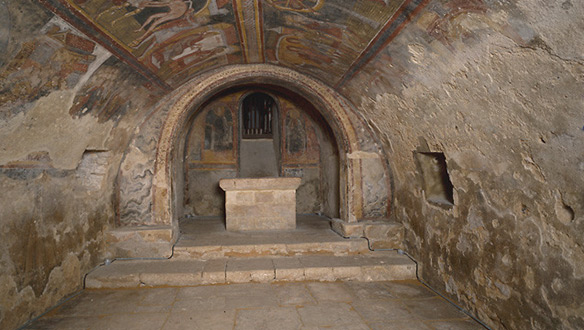 The crypt at the church of Saint-Savin.
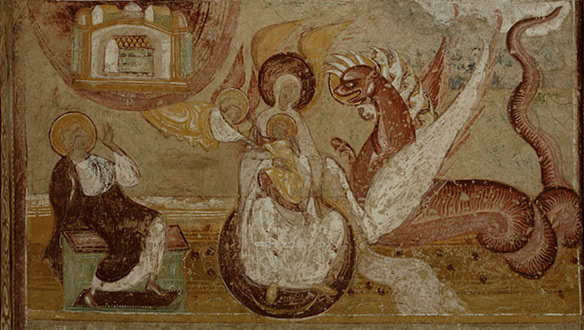 Woman and dragon. Mural painting on the porch of the church.
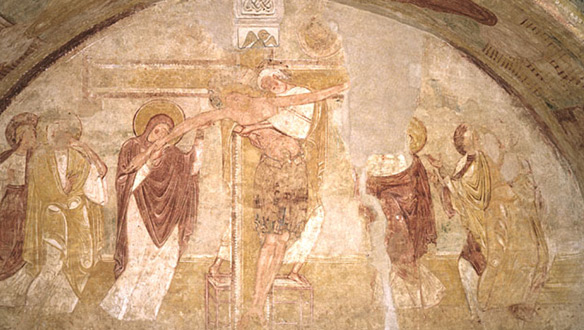 The Descent from the Cross. Mural painting on the tribune of the church’s porch.
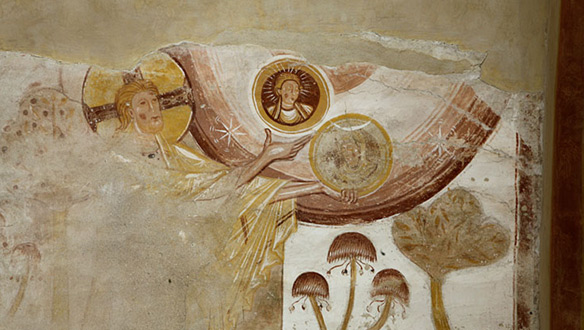 The Creation of the Sun, Moon and Stars. Mural painting on the vault of the church’s nave.
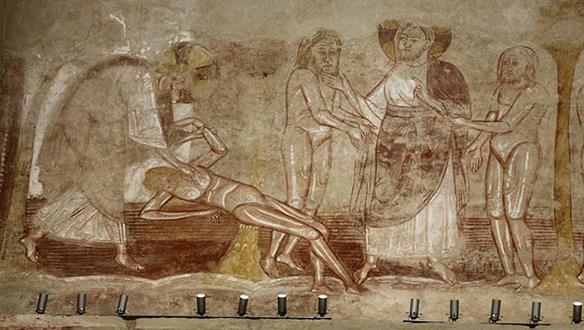 The Creation of Eve and the Presentation of Eve to Adam. Mural painting on the vault of the church’s nave.
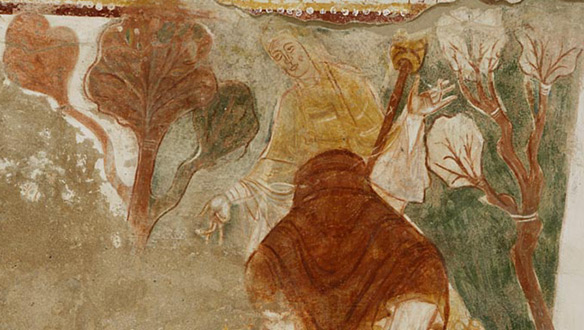 Eve spinning. Mural painting on the vault of the church’s nave.
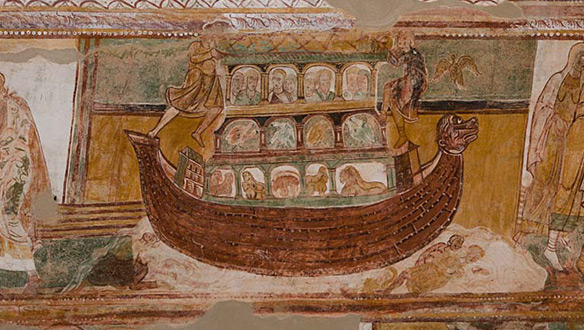 Noah’s Ark and the Release of the Raven. Mural painting on the vault of the church’s nave.
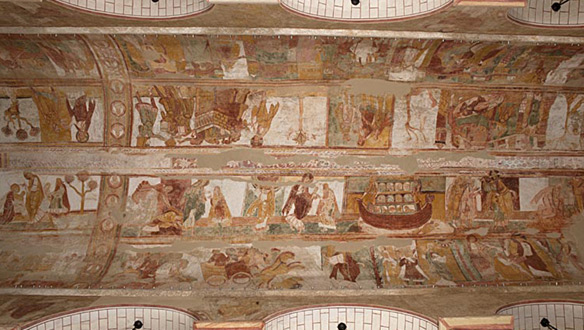 Mural painting on the vault of the church’s nave. Detail on the sixth and seventh aisles.
The 11th century church of the old abbey of Saint-Savin, in the Vienne region, is one of the greatest Benedictine monasteries of Poitou. It is decorated with mural paintings that have become famous since their discovery by Prosper Mérimée in the 1830s. Registered on the first list of Historical Monuments in 1840, this major edifice of the Poitou-Charentes region was named the « Sistine Chapel of the Romanesque World » by André Malraux. It has been listed a World Heritage Site since 1983.
This collection of paintings is one of the biggest in Europe, for the Romanesque period. These paintings are the work of a single team of painters, who worked here around 1100AD, soon after the church was completed.
The paintings cover the bell-tower porch, the nave, the choir and the crypt. While they embellish the
« House of God », they mainly served to accompany the monks in prayer and processions.
Scenes from the Apocalypse are depicted on the bell-tower porch, on the ground floor. Above, scenes from the Passion and the Resurrection of Christ are depicted. The legendary lives of Saint Savin and Saint Cyprian are illustrated in the crypt.
The most developed program is seen on the nave, which is more than 17 m high. It unfolds over the entire vault, on a surface area of 460 m². Except for some rare genre paintings and decorative elements (trees), it illustrates the most important stories of Genesis and the Exodus, the first books of the Bible : Adam and Eve, Caïn and Abel, Noah, Abraham, Joseph, Moses...
The paintings on the vault are organized into five longitudinal friezes. A decorative central strip is surrounded on both sides by two overlapping, historiated friezes, each 2.5 m wide. So most of the figures are represented as bigger than they actually are.
This program is linked to the liturgy (for some authors, it is linked to the liturgy of Easter). Thus, the order of the scenes does not always follow the Biblical order.
Resources
The interviews
- At Chauvigny, the historian Christian Rémy discusses the feudal system and tells us about the castles and the life of the lords.
Download the text - At the Abbey of Marcillac-Lanville, the director of the association Via Patrimoine Lætitia Copin-Merlet discusses the power of the clergy, the construction of numerous churches, the pilgrimages, the peasants and economic development.
Download the text
Focus
- The counts of Poitou
Download the text - The lords : « those who wage battle »
Download the text - The Romanesque castles
Download the text - The Church and the clergy : « those who pray »
Download the text - The peasants, the artisans, the merchants... : « those who work »
Download the text
The interviews
- In the churches of Saint-Eutrope at Saintes and Notre-Dame la Grande at Poitiers, Christian Gensbeitel, lecturer in Medieval Art History, discusses Romanesque art, its origins and its various modes of expression.
Download the text - At the church of Saint-Pierre d'Aulnay, the poet and writer Rémy Prin shares his passion for the Romanesque world and the sculptors’ exceptional work.
Download the text - At the abbey of Saint-Savin, the heritage mediator Marie-Anne Lacaille shows us the remarkable mural paintings that are listed on the World Heritage List.
Download the text
The focus
- The church of Saint-Eutrope at Saintes : an innovative sculpture
Download the text - The church of Notre-Dame la Grande at Poitiers : a new architecture
Download the text - The church of Saint-Pierre at Aulnay : a book of stone images
Download the text - The church of Saint-Savin : the « Sistine Chapel of the Romanesque world»
Download the text
The interviews
- The Regional Curator of Historical Monuments Pierre Cazenave and the Vice-Regional Curator of Archaeology Didier Delhoume, both at the Regional Department of Cultural Affairs of Poitou-Charentes discuss the future restoration of the cathedral of Angoulême’s facade.
Download the text - Anne Embs, the Vice-Regional Curator of Historical Monuments at the Regional Department of Cultural Affairs of Poitou-Charentes and Brice Moulinier, restorer of mural paintings, explain the restoration of the paintings at the templar chapel of Cressac-Saint-Genis.
Download the text - Anaël Vignet, Director of the Center of Romanesque Architecture and cultural mediator at the Abbey of Saint-Amant-de-Boixe, discusses her role as a mediator of Romanesque art.
Download the text -
The designer Mathieu Lehanneur tells us about his work at the church of Saint-Hilaire at Melle, where he redesigned the choir using Romanesque and contemporary styles
Download the text - The audience during the opening night of the Romanesque Nights at Saint-Savin on June 28, 2014. Organized by the Poitou-Charentes Region, the festival celebrated its tenth anniversary and performed 250 free performances and 170 nightly events throughout the summer.
- Angoulême, cathedrale of Saint-Pierre
Discover - Visit - Aubeterre-sur-Dronne, church of Saint-Jean
Discover - Visit - Cressac-Saint-Genis, chapel of the Templars
Discover - Lichères, church of Saint-Denis
Discover - Marcillac-Lanville, church of Notre-Dame
Discover - Saint-Amant-de-Boixe, Abbey of Saint-Amant
Discover - Visit
- Aulnay, church of Saint-Pierre
Discover - Saintes, church of Saint-Eutrope
Discover - Visit - Saint-Sornin, dungeon of Broue
Discover - Talmont-sur-Gironde, church of Sainte-Radegonde
Discover - Visit
- The Romanesque heritage of Poitou-Charentes, on the site of the Heritage Inventory Office of the Nouvelle-Aquitaine Region.
- Romanesque monuments of Poitou-Charentes
- Portal of the Romanesque Era of Poitou-Charentes, designed by the Museum Council, in partnership with the Ministry of Culture and the Poitou-Charentes Region.
- The site of the Regional Office of Cultural Affairs of Nouvelle-Aquitaine.
Credits
A WEB-DOCUMENTARY OF THE NOUVELLE-AQUITAINE REGION

Coordination :
Jean Jay, Yann Ourry
Writing and Editing (focus) :
Véronique Dujardin, Marie-Paule Dupuy, Yann Ourry, Christine Sarrazin, Catherine Tijou.
Interviews with :
Pierre Cazenave, Lætitia Copin-Merlet, Didier Delhoume, Anne Embs, Christian Gensbeitel, Marie-Anne Lacaille, Mathieu Lehanneur, Brice Moulinier, Rémy Prin, Christian Rémy, Anaël Vignet.
Journalist :
Mélody Szymczak
A web-documentary directed and produced by Vue du Phare production.

Director & Executive Producer : Arnaud Chastanet
Producers : Arnaud Chastanet, Amandine Faugeron
Chief Cameraman : Romain Carcanade
Technical Director : Filip Trad
Camera operator : Guillaume Génini
Music & Sound Recording : Augustin Arbon
Editing : Filip Trad, Arnaud Chastanet
Web design : Agence Sweet Punk
Drone pilot : Rémy Semidei
Additionnal drone pilot : Romain Watier
Motion Design : Fabrice Vacher
Calibration : Mathieu Nieto
Journalist : Mélody Szymczak
Voice over : Chloé Dunn
Translation : Tatyana Baishanski
Thanks to the owners and managers of the sites filmed. Special thanks to the EPCC Abbey of Saint Savin / Valley of Frescoes, to the Abbey of Saint-Amant-de-Boixe and to the United Protestant Church of Barbezieux (chapel of Cressac-Saint-Genis).
Disclaimer
Publishing Director : Aurélie Loubes, Director of Communication of the Nouvelle-Aquitaine region.
Publishing : The Heritage Department of the Nouvelle-Aquitaine region.
Status
The territorial authority of the Nouvelle-Aquitaine region
14 rue François de Sourdis
33077 Bordeaux Cedex
Tel : 05 49 36 30 05
Mail : s.patrimoine@nouvelle-aquitaine.fr
Production
Vue du Phare production
Siège social : 57 boulevard Poniatowski 75012 Paris
RCS de Paris : 524 458 262
info@vueduphare.com
Host
Netissime.com - Groupe e.l.b. Multimedia
45/47 rue Francis de Pressensé
69100 Villeurbanne, France
Data Protection
You have the right to access, modify, rectify and delete your personal data on file (article 34 of the Data Protection Act). To exercise this right, send an email to the following address: s.inventaire@cr-poitou-charentes.fr
Copyright and Reuse of Content
All content herein is published by the Nouvelle-Aquitaine Region.
The content herein may not be reproduced without prior consent. Any reuse or reproduction of content must indicate the original source.
To request authorization to reproduce or reuse any content, please contact: s.patrimoine@nouvelle-aquitaine.fr
Furthermore, the reuse or reproduction of any content may only be permitted for personal, organizational or professional purposes. Distribution or reuse for commercial or marketing purposes is prohibited. The establishment of « deep links » to the document in question is promoted, and the reproduction of the content herein must be as limited as possible. Establish a link to the web-documentary « Romanesque Treasures ».
Any Internet site and any other support is authorized to use a hypertext link directing users to this portal. The authorization for the establishment of a link is valid for any and all supports, with the exception of those which disseminate information of a controversial nature, pornographic material or xenophobic material, or those which are liable to offend the greater majority.